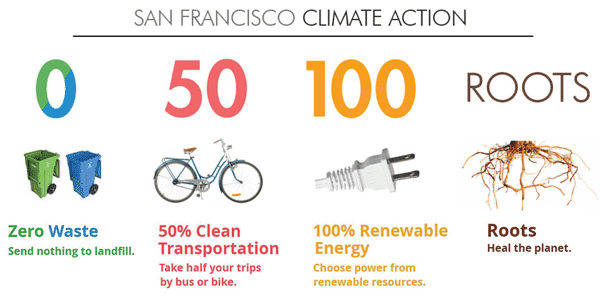
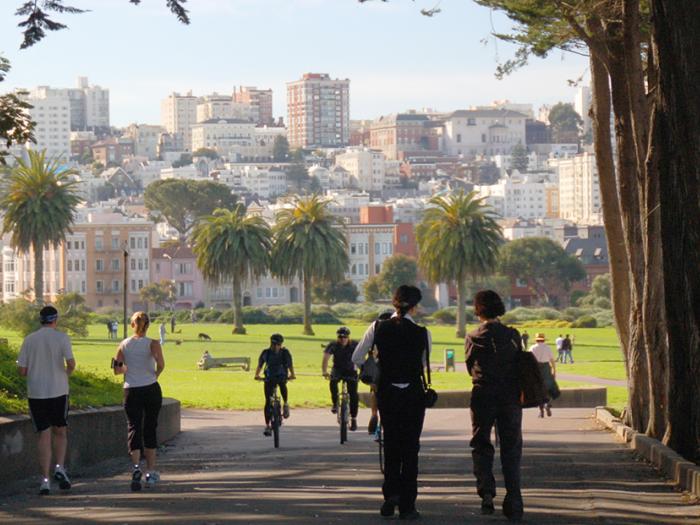
Making the best use of our resources, improving the quality of life for our residents, and spurring economic growth, the Sustainable Development Program explores new options for growth that protects the environment while laying a foundation for prosperity.
Check out our monthly EcoDistrict presentation series!
Program Overview
The Planning Department’s Sustainable Development Program is responsible for balancing San Francisco’s plans for future growth within the context of the State’s requirements to reduce greenhouse gas emissions (AB 32 and SB 375) and the City’s goals to reduce water consumption, reduce waste, and enhance community-scale energy resources. A primary goal of the Sustainable Development Program is to facilitate the implementation of sustainable infrastructure systems by coordinating private development and public improvements through community engagement.
Over the last decade, the Planning Department has planned for significant growth to occur in the city and will continue to do so. State and local environmental goals and requirements mandate that this growth to be more sustainable, particularly in the areas of water and energy conservation and waste reduction. The Sustainable Development Program works to achieve compliance with the existing environmental legislation efficiently and cost effectively, it aims to improve coherence and cost-effectiveness of different policy measures, and it aims to enhance public private partnerships. Eco-Districts have emerged as an important tool of the Sustainable Development Program.
What is an Eco-District?
An Eco-District is defined by its community. Property owners, businesses and residents contribute time, dollars and enthusiasm to identify, prioritize, and implement sustainable development projects in the area. Eco-Districts are neighborhood scale public-private partnerships that can strengthen the economy while creating a stronger sense of place. Creating eco-districts can help achieve the goals of city’s Climate Action Plan, Electricity Resource Plan and Green Building Ordinance.
The Planning Department has identified four types of Eco-Districts in San Francisco:
Type 1: The Blank Slate
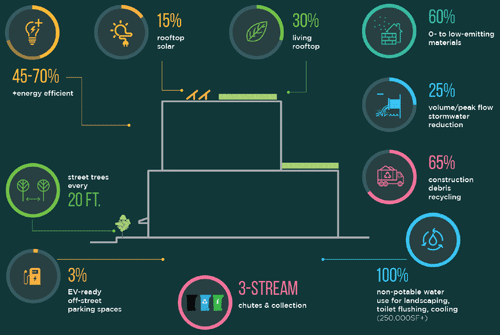
The Type 1 Eco-District is characterized by a large amount of undeveloped land typically owned by a single property owner. Type 1 Eco-Districts enable horizontal infrastructure development to be implemented in advance of vertical development to help optimize Eco-District goals. This type of Eco-District maximizes efficiencies in the delivery of goods provided by infrastructure through district-scale systems.
Type 2: The Patchwork Quilt
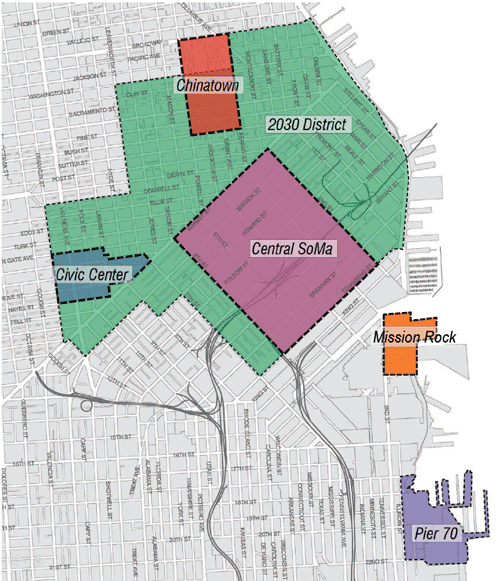
The Type 2 Eco-District is characterized by its mix of land uses and is comprised of undeveloped, underdeveloped, and developed land owned by different property owners implementing development projects under different timeframes. This type of Eco-District focuses on aligning development timeframes to maximize opportunities to meet environmental goals. It also works closely with the community to build on its existing character and to integrate the physical qualities of the area as part of its character. Our Central Corridor Plan area has been identified as a Type 2 Eco-District.
Type 3: The Strengthened Neighborhood
The Type 3 Eco-District, in coordination with the Office of Economic and Workforce Development’s Invest in Neighborhoods Initiative, focuses on existing residential neighborhoods and their commercial corridors. Type 3 Eco-Districts are located in parts of the city that are not planned to accommodate growth, but through tactical urbanism can bolster distinctive character and support eco-friendly behavior.
Type 4: The Industrial Network
The Type 4 Eco-District focuses on creating stronger connections between the city’s production, distribution, and repair (PDR) uses. PDR has been recognized as an important component of the city’s culture, its economic stability, and the retention of its diverse labor force. Aligning these industries so that their operating and distribution systems can work more efficiently is the primary focus of the Type 4 Eco-District.
EcoDistrict Presentation Series
The Planning Department hosts a monthly presentation series. The series is a popular forum for the discussion of issues relating to EcoDistrict development in the City. Guest speakers from backgrounds related to sustainability, environmental infrastructure systems, and EcoDistricts are invited to present their work to the city’s Inter-Departmental EcoDistrict team and discuss a particular subject relevant to the team’s work. Depending on the speaker, the discussion series deals with very practical issues of how and what is being developed in San Francisco, the Bay Area, other cities in the country, and abroad. Speakers relate their specific area of interest to the Sustainable Development Programs goals and provide valuable context for staff in terms of how and what may be considered in implementing EcoDistricts in the city. As important, the discussion engages the opinions of people from a variety of backgrounds, broadening everyone’s perspective and encouraging in the sharing of ideas.
ECODISTRICT PRESENTATION
Investing in Resilience and Reinvesting in Communities
Speakers: Celeste Connors, co-founder of c.dots and Re.invest Initiative; Shalini Vajihala, co-founder of c.dots development and the Re.invest Initiative; and Elle Beard, project manager for the Re.invest Initiative. ( bios ) Date: Monday, June 17, 2013
Time: 12:00 - 1:00 PM
Where: San Francisco Public Utilities Commission, 2nd Floor, O’Shaughnessy Room
525 Golden Gate Avenue, Public Utilities Commission Building ( map )
The SF Public Utilities Commission building is wheelchair accessible. To request any other disability accommodations please contact Kate McGee at 415-558-6367 or kate.mcgee@sfgov.org at least three business days in advance. Please refrain from wearing scented products to this event.
Cities across the country are facing challenges with rebuilding their aging water, energy, and transportation systems. More specifically, in San Francisco, the City is trying to meet the demands of growth while adapting to climate change.
Re.invest Initiative is a collaboration among engineering, law, finance firms, and eight partner cities, including San Francisco. The goal of Re.invest is to help cities design a more flexible, sustainable and integrated infrastructure network and use public resources more efficiently to leverage private investment in building stronger communities.
At this EcoDistrict presentation, speakers from the Re.invest team will discuss the development of the initiative, the work that Re.invest will be doing with San Francisco, and the long-term impact that the organization hopes to have across the country.
About Re.invest: Re.invest is a public-private initiative to mobilize private investment to help city governments build more resilient and integrated urban infrastructure systems. The project is spearheaded by c.dot development
----
Celeste Connors: Co-Founder of c.dots development and the Re.invest Initiative
Celeste has over a decade of experience working at the intersection of economic, trade, environment, energy, and international development policy. Before starting c.dots development, Celeste was the Director for Environment and Climate Change at the National Security Council and National Economic Council in the White House, where she helped shape the Administration's economic priorities and initiatives. Celeste holds an M.Sc. in Development Studies from the University of London's School of Oriental and African Studies (SOAS) and a B.A. in International Relations from Tufts University.
Shalini Vajihala: Co-Founder of c.dots development and the Re.invest Initiative
Shalini is an architect with an interdisciplinary background and expertise in green design, engineering, economics, and policy. Before starting c.dots development, Shalini served as Special Representative in the Office of Administrator Lisa Jackson at the US Environmental Protection Agency. Shalini received her Ph.D. in Engineering and Public Policy from Carnegie Mellon University, and was an architect and community organizer in Pittsburgh before moving to Washington, D.C.
Elle Beard: Project Manager for the Re.invest Initiative
Elle has a background in public policy, but has focused most of her career on finding innovative and interesting partnerships between government and the private sector. Prior to joining The RE.invest Initiative Elle served as Special Assistant in the U.S. EPA's Office of International and Tribal Affairs where she developed and supported a number of initiatives on behalf of then EPA Administrator Lisa Jackson. Elle has B.A. in Public Policy with a focus on Globalization and its Impact on Cooperation from the University of Michigan Gerald R. Ford School of Public Policy.
PAST PRESENTATIONS
| Date |
Presentation
|
Speaker(s)
|
| May 20, 2013 |
EDF Presentation
|
Professor Jean Claude van Duysen, Dr. Jamie Link, Gabriel Meric de Bellefon |
| Apr. 15, 2013 |
5D Cities: An All Inclusive Approach to Open Data |
Michael Jansen |
| Mar. 18, 2013 |
Treasure Island / Yerba Buena Island Development Project’s Sustainability Plan and District Scale Infrastructure Opportunities |
Michael Tymoff |
| Feb. 4, 2013 |
Building Water Reuse Opportunities in San Francisco |
Paula Kehoe |
| Nov. 7, 2012 |
Transformative Energy and Water Infrastructure for Neighborhoods |
Claire Maxfield, Emma Marchant |
| Oct. 1, 2012 |
Ownership Models for Sustainable Neighborhood Infrastructure |
Trent Berry |
| Sept. 5, 2012 |
Investigating New Business Models to Make Cities Smarter and More Successful |
Tom Osdoba |
| May 24, 2012 |
Optimizing Systems at District Scale |
Alisdair McGregor, Jordan O'Brien, Bry Sarté, Clark Brockman |
| April 5, 2012 |
Central Corridor EcoDistrict: Integrated Water Resource Management |
Zach Gallagher |
Contact
For more information about the Sustainable Development program, please contact:
Kate McGee
Lead Sustainability Planner / Program Manager
San Francisco Planning Department
(415) 558-6367
kate.mcgee@sfgov.org