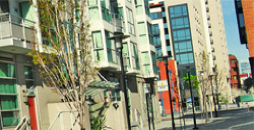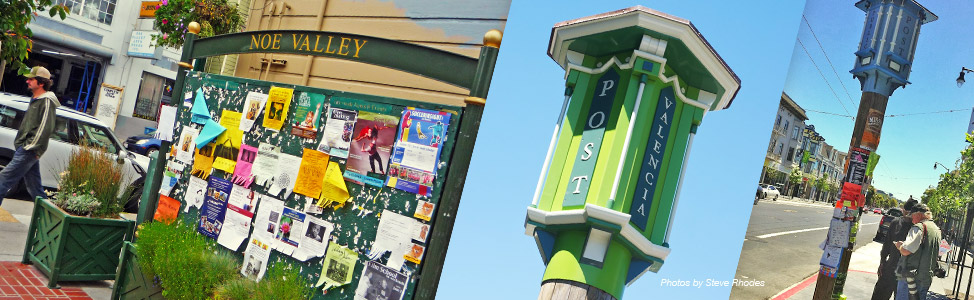
| The term “pedestrian environment” refers to the areas of the street where people walk, shop, sit, play, or interact – outside of moving vehicles. Generally speaking, this refers to the sidewalk areas between the property line and the curb, and the crossing areas at intersections. However, the pedestrian environment can also include portions of the street normally associated with vehicular traffic—such as during street fairs or farmer’s markets, or parking lanes that are temporarily used for other activities, or the entire street on small-scale, slow-moving streets such as alleys, public staircases, or pedestrian pathways. |
|
||||||||||||||||||||||||
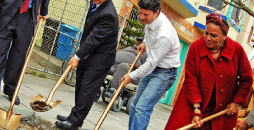
The Better Streets Plan creates a unified set of standards, guidelines, and implementation strategies to govern how the City designs, builds, and maintains its pedestrian environment. The Better Streets Plan process brings together staff of multiple City agencies to comprehensively plan for streets. The Plan seeks to balance the needs of all street users, with a particular focus on the pedestrian environment and how streets can be used as public space. The Plan reflects the understanding that the pedestrian environment is about much more than just transportation – that streets serve a multitude of social, recreational and ecological needs that must be considered when deciding on the most appropriate design. The Better Streets Plan carries out the intent of San Francisco's Better Streets Policy, adopted by the Board of Supervisors on February 6, 2006. |
||||||||||
info:
(415) 558-6405 | info@sfbetterstreets.org
|

This
project is made possible by the San Francisco County Transportation Authority
through
a grant of Proposition K Local Transportation Sales Tax Funds.